
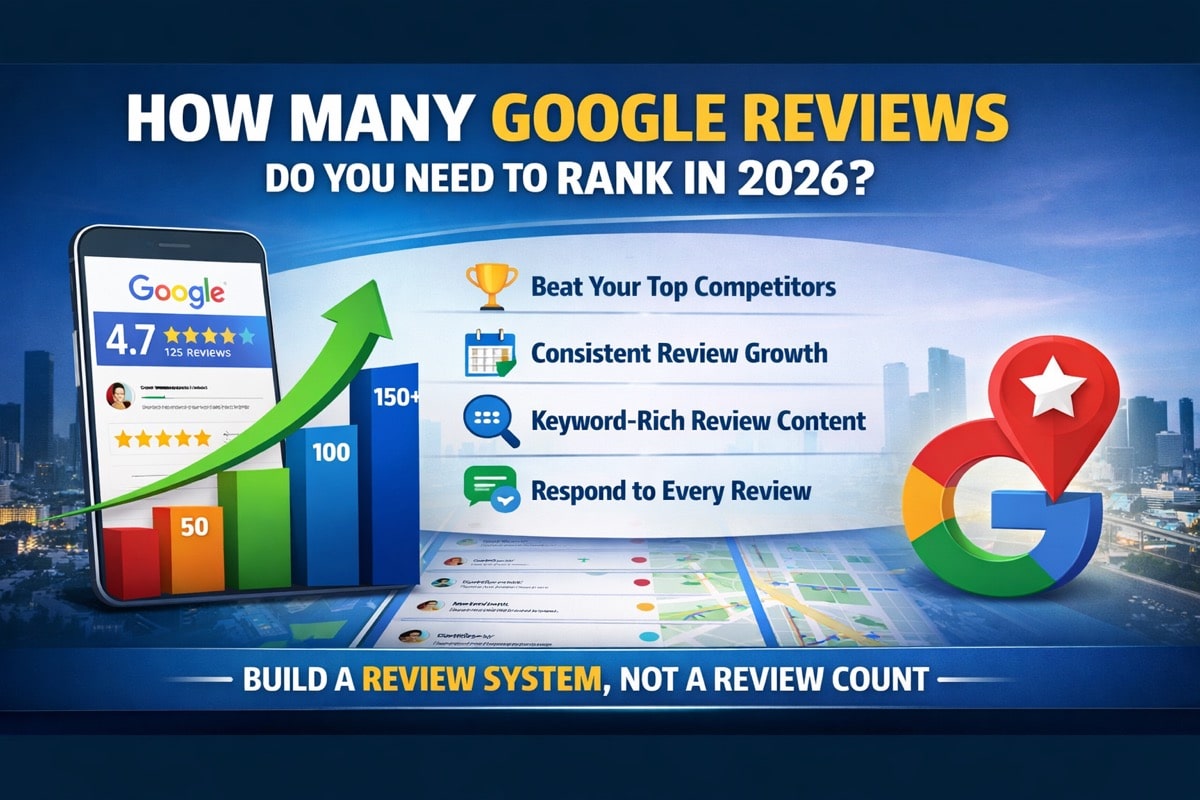
Discover the data-driven benchmarks, competitor analysis framework, and review velocity strategy you need to dominate Google’s Local Pack rankings in 2026.
If you're a local business owner asking:
“How many Google reviews do I need to rank in 2026?”
You're asking the right question — but the wrong way.
Because in 2026, Google doesn’t rank businesses based on a fixed review number.
It ranks businesses based on competitive prominence, review velocity, sentiment signals, and engagement behavior.
Let’s break it down properly.
The Short Answer
There is no universal number.
Instead:
- You need more high-quality reviews than the average of your top 3 competitors
- You need consistent monthly review velocity
- You need natural review content
- You need response engagement
In most mid-sized U.S. markets:
- 50 reviews = entry-level competitiveness
- 100 reviews = strong visibility
- 150+ reviews = authority positioning
But that’s only part of the story.
How Google Uses Reviews in 2026 (AI-Based Ranking Signals)
Google’s local ranking system evaluates:
 Review Quantity
Total review count relative to competitors.
 Review Velocity
How often you receive new reviews.
 Review Recency
Fresh reviews signal active business operations.
 Sentiment & Text Analysis
Google AI analyzes keywords inside reviews.
 Owner Response Behavior
Consistent engagement improves trust signals.
Reviews impact the “Prominence” pillar of local SEO.
Prominence + relevance + distance = Local Pack rankings.
The Competitive Formula (What You Should Actually Do)
Step 1: Search Your Primary Keyword
Example:
- “Electrician in Dallas”
- “HVAC repair near me”
- “Dentist in Miami”
Step 2: Analyze the Top 3 Google Map Results
Check:
- Review count
- Star rating
- Review recency
Step 3: Beat the Average by 20–30%
If Top 3 average = 82 reviews
Your target = 105+
This gives algorithmic advantage.
Industry Benchmarks for 2026
| Industry | Competitive Range |
|---|---|
| Electricians | 40–150 |
| HVAC | 60–200 |
| Dentists | 80–250 |
| Attorneys | 30–120 |
| Med Spas | 100–300 |
| Restaurants | 300–2000+ |
 Restaurants are outliers. Service businesses require fewer reviews to compete.
Why Review Velocity Matters More Than Total Count
Google rewards:
 Consistent growth Natural patterns Active engagement
If you get:
- 50 reviews in one week → suspicious spike
- 5 reviews per month → stable authority
The businesses that rank in 2026 treat reviews like marketing infrastructure — not random requests.
What’s the Ideal Star Rating?
Surprisingly:
- 4.2 – 4.8 = highest conversion
- 5.0 perfect rating can reduce trust
- 4.3 often converts better than 5.0
Consumers trust realistic businesses.
How Long Before Reviews Impact Rankings?
Generally:
- First 20 reviews → noticeable improvement
- 40–60 reviews → stronger Map visibility
- 80–120 reviews → stable Local Pack presence
Assuming:
- Optimized Google Business Profile
- Correct categories
- Strong website SEO
- Consistent NAP citations
Reviews amplify — they don’t replace foundation SEO.
The 2026 Review Growth Strategy (Systemized Approach)
Here’s what winning businesses do:
Ask Immediately After Service
Best window = within 2 hours.
Use SMS + Email Automation
SMS converts 3–5x higher than email.
Send Reminder After 48 Hours
Respond to 100% of Reviews
Train Staff to Pre-Frame the Ask
Consistency compounds.
Why Most Businesses Fail at Review Growth
Because they:
- Rely on manual asking
- Forget to follow up
- Don’t track review velocity
- Have no automation system
- Don’t monitor competitor growth
That’s why businesses plateau at 25–40 reviews.
And competitors pass them.
The Real Question: Do You Have a Review System?
If you're serious about ranking in 2026, you don’t need:
 A random number goal
You need: A structured reputation management system
That means:
- Automated review requests
- Real-time monitoring
- Negative review alerts
- AI-assisted response drafting
- Multi-location tracking
Without automation, review growth is inconsistent.
Frequently Asked Questions
Is 20 Google reviews enough?
Only in small towns with low competition.
Can fake reviews help?
Short term? Possibly.
Long term? Google AI spam detection will catch it.
Do reviews influence PPC performance?
Yes. Higher ratings improve click-through rate in Local Service Ads.
Do old reviews lose value?
Yes. Recency is weighted heavily in 2026.
Final Verdict
You don’t need a magic number.
You need:
- To beat your local competitors
- To grow reviews monthly
- To maintain natural patterns
- To respond consistently
- To systemize reputation management
Businesses that win in 2026 don’t chase review counts.
They build review engines.
 Ready to Build a Review Engine?
If you're tired of:
- Manually asking customers
- Losing leads to competitors
- Watching competitors outrank you
- Getting surprised by negative reviews
It’s time to automate.
 Discover how our platform helps businesses generate, monitor, and respond to reviews — automatically.